


Why Meal Planning Works Better When It Understands Your Real Life

Most meal plans look useful before the week begins.
There is a grocery list, a few dinner ideas, maybe a breakfast option, maybe something to pack for lunch. Everything seems reasonable while the fridge is still full and the week has not started asking for favors.
Then real life begins.
A meeting runs late. Someone eats the leftovers you planned to use for lunch. The produce that looked good at the store gets pushed behind other containers. The recipe you saved needs more chopping than you have patience for. One night becomes takeout, not because the plan was terrible, but because the plan did not match the way the week actually unfolded.
This is the limitation of many food planning systems. They help people decide what to eat, but they often miss the personal context that determines whether the plan will actually be used.
A useful meal planning app should not act like a food coach with one fixed philosophy. Macaron is more interesting as a personal AI agent because it can work from the details of a person’s real life: what they already buy, what usually goes to waste, which nights are busy, what foods their household repeats, how much time they have to cook, and which meals need to be flexible rather than perfect.
The best food plan is not the one that looks most organized.
It is the one that still helps when the week stops behaving.
Start With the Week, Not the Recipe
A common mistake is starting with recipes before looking at the calendar.
Recipes can be inspiring, but they do not know that Wednesday is a late work night, Thursday has an evening workout, and Saturday includes errands, family plans, or travel. They do not know that lunch is the meal most likely to fall apart, or that the household is tired of eating the same leftovers by day three.
A better planning process starts with the week’s pressure points.
Before choosing meals, identify the two or three moments when food usually becomes inconvenient. That might be rushed breakfasts, forgotten lunches, after-work dinners, snacks before workouts, or the night when everyone eats at a different time.
For example, a realistic weekly note might look like this:
- two lunches need to be packable;
- one dinner needs to take less than 15 minutes;
- one night will probably involve leftovers;
- produce should be used earlier in the week;
- one backup meal should be available for a low-energy night.
This is not a diet rule. It is logistics.
Meal planning becomes more useful when it begins with the parts of the week that need support.
A Grocery List Should Solve Specific Problems
A grocery list that says “vegetables, protein, grains, snacks” may be technically correct, but it does not always help enough.
The better question is: what problem is each item solving?
Eggs may solve rushed breakfasts. A cooked grain may solve two lunches. Frozen vegetables may solve a weeknight dinner. Yogurt may solve post-workout hunger or afternoon snacks. A sauce or dressing may make leftovers feel less repetitive. A pantry backup may prevent takeout from becoming the only option.
When every item has a job, the grocery list becomes easier to use.
Here is a simple way to build a more practical list:
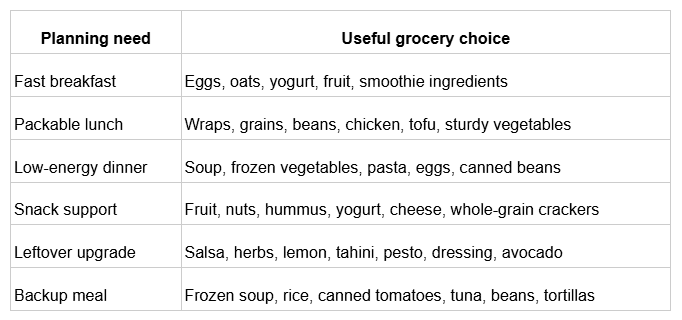
The goal is not to buy the “perfect” cart.
The goal is to buy food that fits the week well enough to become meals.
Plan the Order of Use
Many food plans fail because they focus only on what to buy.
The order of use matters just as much.
Some foods can wait. Others need attention early. Greens, herbs, berries, ripe avocados, fresh fish, cut vegetables, opened containers, and cooked grains all have a limited window. If they do not have a clear role, they are easy to forget.
A simple “use first” plan can reduce waste and make decisions easier.
It might be as simple as:
Use early: greens, herbs, berries, fresh fish, ripe fruit.
Use midweek: cooked grains, roasted vegetables, opened hummus, prepared protein.
Keep for backup: frozen vegetables, eggs, canned beans, soup, pasta, rice.
This small step changes the way a fridge works.
If the greens are assigned to Monday lunch, they are less likely to become Friday guilt. If the cooked rice is marked for Tuesday bowls, it is less likely to sit untouched. If frozen vegetables are saved for a low-energy dinner, they become part of the plan instead of an afterthought.
A good food plan should help ingredients move through the week.
Make the Plan Flexible Without Making It Vague
Flexibility is useful only when it has structure.
A plan that is too strict fails when life changes. A plan that is too vague leaves every meal to be decided from scratch. The middle ground is to plan meal formats rather than exact meals.
For example:
- one bowl night;
- one soup or pasta night;
- one leftover remix;
- one quick egg or toast meal;
- one flexible dinner from pantry staples.
This gives the week shape without locking every meal into a specific recipe.
A bowl night can use rice, quinoa, greens, roasted vegetables, chicken, tofu, beans, salsa, or dressing. A leftover remix can turn cooked protein into wraps, salads, pasta, or tacos. A pantry dinner can use eggs, beans, frozen vegetables, soup, or noodles depending on what is still available.
The format creates direction. The ingredients allow adjustment.
That is often more realistic than assigning seven exact dinners and hoping nothing changes.
Let Personal Preferences Matter
A meal plan that ignores preferences will not last.
Some people enjoy cooking several nights a week. Others want as little cooking as possible after work. Some households like leftovers. Others need leftovers to become something different. Some people prefer warm lunches. Others need food that can be eaten cold. Some shoppers buy fresh produce often. Others rely more on frozen and pantry staples.
None of these is automatically better.
They are simply different realities.
This is where personal AI becomes more useful than a static template. A generic plan may suggest meals based on category or nutrition style. A personal AI can work from repeated patterns: what someone actually cooks, what gets ignored, which nights are rushed, what food preferences matter, and which shortcuts still feel acceptable.
That distinction is important.
Macaron should not be understood as a tool that tells everyone to eat in one approved way. Its stronger value is helping a person turn their own context into a practical system.
Use Leftovers as Ingredients, Not Assignments
Leftovers often fail because they feel like homework.
The container is there. Everyone knows it should be eaten. Nobody wants the same dinner again.
A better approach is to store leftovers so they can become ingredients.
Cooked chicken can become wraps, salads, rice bowls, soup, or tacos. Roasted vegetables can go into eggs, pasta, grain bowls, or sandwiches. Rice can become fried rice, a burrito bowl, or a side for a quick dinner. Beans can become soup, toast topping, salad protein, or taco filling.
The key is to avoid making leftovers feel like a repeated plate.
A small change in format can make the same food feel useful again.
For busy weeks, this matters more than variety for its own sake. One cooked base that becomes two or three different meals can reduce both food waste and decision fatigue.
Keep One Backup Meal That Does Not Require Motivation
Every weekly plan needs one meal for the night when cooking energy disappears.
Not a “perfect” meal. A realistic one.
It should use ingredients that last, require little preparation, and still feel like food you are willing to eat. That might be eggs and toast, soup and salad, beans and rice, pasta with vegetables, a smoothie and snack plate, tacos from pantry staples, or frozen vegetables with a quick protein.
The backup meal prevents one difficult night from breaking the whole week.
It also reduces the emotional weight of meal planning. The question becomes less about whether the week went perfectly and more about whether the plan had enough support when the week became inconvenient.
That is a more realistic standard.
A Sample Personal Food Plan
Here is what a neutral, real-life food plan can look like.
The week includes two late workdays, one evening workout, one dinner out, and limited time for cooking.
The pressure points:
- lunch needs to be easy to pack;
- dinner after the workout needs to be fast;
- fresh produce should be used early;
- one backup meal should be ready.
The grocery list:
- eggs;
- yogurt;
- rice or quinoa;
- chicken, tofu, or beans;
- greens;
- carrots or cabbage;
- frozen vegetables;
- hummus;
- salsa or dressing;
- soup or pasta for backup.
The plan:
Monday lunch uses greens and protein.
Tuesday dinner uses rice, vegetables, and sauce.
Wednesday lunch becomes leftovers in a wrap or bowl.
Thursday after the workout uses eggs, soup, or a quick bowl.
Friday stays flexible because dinner out is already part of the week.
Nothing here is tied to one food philosophy.
It is simply a plan built around what the week needs.
Better Planning Starts With Personal Context
Food planning is often treated as a recipe problem.
For many people, it is really a context problem.
They do not need more perfect menus. They need a plan that understands time, energy, leftovers, preferences, shopping habits, food waste, family schedules, and the nights when decision-making is already gone.
That is why the future of meal planning should feel less like a fixed template and more like a personal assistant for everyday logistics.
The plan should know what needs to be used first. It should help turn groceries into meals. It should make room for shortcuts without turning them into failure. It should adapt when the week changes. It should help people eat in a way that fits their own life, not someone else’s rules.
A better meal plan does not need to sound strict.
It needs to be useful when dinner is still undecided and the day has already been long.