


Commercial Kitchen Tools for Serious Home Cooks
The line between home and restaurant cooking has narrowed sharply in the last decade. Heavy-duty stand mixers, induction ranges with restaurant-grade burners, sous-vide circulators, and full-tang chef knives have moved from professional kitchens into ambitious home setups. The shift is real, and the home cook who plans the upgrade carefully ends up with equipment that lasts 15 to 20 years rather than 2 to 3.
The same disciplined evaluation that informs a recipe-development process translates to the equipment decision. Canadian homecooks exploring the commercial route through retailers like Chef Stop often find the multi-vendor model fits their needs. Chef Stop is an Ontario-based commercial-kitchen-equipment supplier serving restaurants and serious residential cooks. The right supplier reads the cook's actual workflow first and matches equipment afterward. The decision rewards a few hours of structured homework before the first major purchase.
Why Has Commercial-Grade Equipment Moved Into HomeKitchens?
Commercial-grade equipment is gear engineered for 8 to16 hours of daily service in a restaurant rather than 30 to 60 minutes of evening use at home. Three structural shifts have moved this gear into the homemarket. The first is the pandemic-era home-cooking boom, which lifted residential equipment budgets meaningfully and gave home cooks the time to learn how to use serious tools.
The second is the supply-side shift. Equipment retailers that once served only restaurants now sell to home cooks directly. The price gap between top-tier residential and entry-level commercial has shrunk to 20 to40 percent in many categories.
The third is the durability calculation. A commercial 8-quart stand mixer rated for daily restaurant service will absorb decades of weekend home use without showing wear. The same applies across stovetops, ranges, ovens, knives, and food processors.
What Should Home Cooks Verify Before Buying Commercial Equipment?
Six checks belong on every shortlist. The table below summarizes the priorities for serious home cooks.
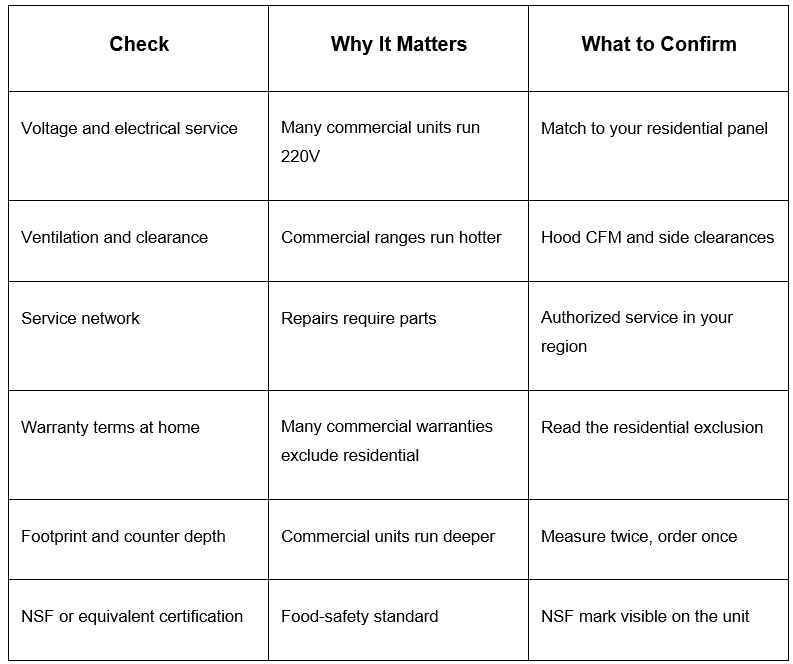
A retailer that produces clear answers across these six points signals a vendor worth working with. A retailer that deflects on any of them signals a shop that may not match the home-cook situation. Asking these questions early saves real money over the equipment's lifetime.
Which Commercial-Grade Categories Reward the Home CookMost?
Three categories reward the upgrade more than the others. The first is the chef knife. A 240mm or 270mm full-tang chef knife holds an edge through 6 to 12 months of daily home use. A $40 residential knife typically manages only 6 to 8 weeks.

The second is the stand mixer. A commercial 8-quart bowl-lift mixer handles dough quantities that overwhelm a residential 5-quart unit. The same patience required for classic shrimp risotto technique is what makes the upgrade worth it.
The third is the cutting board. A commercial-grade-and-grain hardwood board at 18 by 24 inches outlasts the typical residential bamboo board by a factor of 5 to 10. The FDA Safe Food Handling guide outlinescross-contamination practices commercial boards make easier to follow.
What Common Mistakes Surface When Home Cooks Buy Commercial Equipment?
Several patterns recur. The first is buying for aspiration rather than use. The home cook who bakes once a month does not need a 60-quart commercial mixer.
The second is overlooking electrical and venting requirements. A commercial range that needs 220V service or a 600 CFM hood is not a drop-in replacement for a residential unit.
The third is skipping the warranty fine print. Many commercial warranties explicitly exclude residential use, leaving the home cook with no recourse on a $5,000 purchase. The fourth is under-investing in the surrounding workflow. The same technique-compounding visible in a perfectly baked tray of chicken wings only matters when the surrounding workflow (prep, mise en place, storage) supports it.
The fifth is treating food-safety standards casually at the home scale. Commercial equipment is built around standards like those in the CDC Food Safety overview. Home cooks who skip the equivalent practices give up the safety advantage commercial gear provides.
What Is the Bottom Line for Serious Home Cooks?
The commercial-equipment decision rewards the homework discipline a serious home cook already applies to recipe development. The window allows for two or three serious supplier conversations rather than one impulse purchase at a big-box retailer. The right supplier reads the cook's actual workflow and explains the trade-offs in plain language.
Whether the cook is a weekend baker, a daily home chef,a small-batch caterer, or a recipe-tester, the criteria translate cleanly. The first conversation should answer specific questions about voltage, venting,service network, and warranty coverage. Cooks who run real comparisons end up with better-fitting equipment at lower lifetime cost than cooks who default to whichever ad they saw last.
Frequently Asked Questions
Is Commercial Kitchen Equipment Worth the Higher Upfront Cost?
For serious home cooks, often yes. The price premium runs 20 to 40 percent over top-tier residential equipment, but the durability gap is much larger. A commercial mixer rated for 10 years of daily restaurant service typically lasts 25 to 30 years at home use cadence. The total cost of ownership usually favors the commercial unit for cooks who use the gear weekly.
Will My Home Electrical and Venting Handle CommercialEquipment?
Sometimes, but verification matters. Many commercial ranges and ovens require 220V service and 600 to 1,200 CFM ventilation hoods, which residential kitchens often lack. A licensed electrician and HVAC contractor should review the panel and venting before any major commercial-equipment purchase. Smaller units like mixers and food processors typically run on standard 120V.
Do Commercial Warranties Cover Home Use?
Often not. Most commercial warranties explicitly exclude residential installations, treating them as misuse. Read the warranty before purchase, ask the supplier whether residential service is supported, and check whether a separate residential warranty is available. Some commercial brands offer home-use warranty riders for an additional 10 to 20 percent of the purchase price.
How Do I Find Authorized Service for Commercial Equipment at Home?
Ask the supplier for the authorized-service network in your region before purchase. Major commercial brands typically have a 50 to 100mile service radius around metro areas. Outside those radii, the home cook may face longer repair turnarounds and higher service-call fees.
Confirm the nearest authorized technician's distance during the buying conversation. A few suppliers carry residential-service partnerships for home cooks who buy commercial gear, which is worth asking about before committing to a brand. The right service network turns a long-term commercial investment into a low-friction one with manageable upkeep over the years.